Part 1: How Not to Play the Opening in Master of Orion*
* - Unless the circumstances are just right and you're good and/or lucky enough to get away with it.
This must be Thursday. I never could get the hang of Thursdays.
-Arthur Dent
On this particular Thursday, something was moving quietly through the ionosphere many miles above the planet Moro Prime: It was a large, green, rounded something that Ford Prefect, were he living on the planet below, might have recognized gratefully as a kind of flying saucer in the traditional space livery of the Betelgeuse trading scouts. Sadly however, the flying saucer in question was not itself a scout: It was a full-fledged Betelgeusian colony ship in search of a good place to settle down and establish a colony of some kind - preferably one with a really nice pub. And more sadly still for everyone involved not named Ford Prefect, and for the colony ship most of all, Ford Prefect was not living on the planet below, and neither was anyone or anything else: A direct result of the massive over-abundance of Lashburnium crystals across the planet's entire surface.
The Hitchhiker's Guide to the Galaxy has this to say about Lashburnium crystals:
Lashburnium crystals are some of the rarest and most valuable things in the galaxy that you don't want to get anywhere near without a lead body suit. Nobody has yet found a way to make a Kill-O-Zap gun with a tiny Lashburnium crystal for the power cell because every attempt has either resulted in a gun too heavy - with all the shielding - to be carried by any lifeform smaller than a Gargandian Gigasaur, or one that would kill the operator with radiation poisoning while being examined on the sales counter. Lashburnium crystals are tremendously useful for powering well-shielded engines and weapons systems aboard major space cruisers, and the smallest ones are used by Vogons when they want to preserve certain city blocks from decay by rendering them uninhabitable even for bacteria and persistent fungi for a period of several million years.

Three years before, the Betelgeuse trade council had celebrating the launch of their first colony ship by sending it out blind toward the center of the galaxy - or as nearly toward the center as they could, given its limited fuel capacity - decking it out in the festive green of their scout service since they hadn't thought to send any other ships ahead of it to actually scout the system for habitable worlds. One of the two scouts that they had built around the same time - being little more than enormous fuel tanks strapped to rocket engines - had been dispatched instead toward a distant yellow star beyond Moro and another red star called Toranor that might have seemed a more logical colony destination to an organization more interested in reasonable travel times than in the Betelgeuse trade council's combination mission statement and feverish obsession: "Expanding trade across the entire galaxy!"
That other organization would have had it right. Toranor, targeted for scouting because some lonely voice of reason had managed to opine, "Just in case, shouldn't we get some idea of what's closer to home before we actually plant a colony?" held a bright little ocean world, dotted with tiny, lush, beautiful islands consisting mostly of little stands of fruit trees and wide pebbly beaches: The only thing that kept the place from being renamed Paradise was the outcry of popular opinion against the sheer exclusivity of the place: Even including underwater plexiglass domes with spectacular views of the planet's coral reefs, there was precious little space to live on Toranor 3 in comparison with the lively worlds orbiting Betelgeuse. That - and the fact that when the planet was discovered, the lone colony ship assembled by the Betelgeuse trading scouts was well on its way to Moro. Even once it arrived and found nowhere in the entire Moro system capable of supporting a family of cockroaches for more than a minute or two, it was light-years away from Toranor, and even with the jump to hyperspace, wouldn't arrive there until a good four years later than it might have had it headed there right away from Betelgeuse.

Meanwhile, back at Betelgeuse itself, still more of the far-reaching, rickety trading scouts that would one day be famous across the galaxy had been assembled and dispatched - mostly - toward the outer reaches of their particular corner of space. Another organization might have focused on factories for a while before augmenting their initial fleet, but the cool cats of Betelgeuse were driven by nothing if not by curiosity, and couldn't wait to see what awaited them in the galaxy.
It might be supposed that the same curiosity drove them to investigate the field of planetology when they'd still only barely begun to develop their homeworld's infrastructure, but really it had more to do with their scouts' recent confirmation that there was no overwhelming and immediate need to learn how to live on barren rocks, giving them free reign to indulge their eagerness for creating wide-open spaces and for keeping their homes fastidiously clean.

The Betelgeuse scientific community, whose members regularly - and mostly accidentally - littered their labs in the debris of various Important Experiments for the Advancement of Knowledge in the Galaxy, would have loved more than anyone to develop improved measures for cleaning up those kinds of messes ... especially considering that most of the explosive experiments in question were in fields of biology! Sadly however, the plans for just such measures all were lost in a burst of paisley light and the stomach acids of someone's pet genetic mutant, in a terrible accident that was definitely probably not a practical joke at a lab partner's expense, and the plans were never recovered successfully. By a stroke of good fortune however, a seed sample from a culture of certain heavily-hybridized grasses so invasive that they could generally transform any landscape in which they established a foot-hold - be it a tropical rainforest or a sliding glacier, a hillside garden or an unimportant low-tech municipality - into a kind of savanna featuring particularly delicious grain seeds, though they functionally included only a single variety. As far as the cool cats of Betelegeuse were concerned though, this was perfectly acceptable: If the likes of

It was a Thursday again in 2306 when the colony ship touched down on the surface of Toranor 3, among some of the tallest and most-closely clustered islands on the surface of the world. Perhaps for that reason - few people in the long history of the galaxy have ever really gotten the hang of that particular day of the week - or perhaps because she wanted to save the decision-makers back at Betelgeuse a certain amount of embarassment - the camerawoman responsible for the new colony's publicity shots recorded the wrong Official Trade Council Year. As she did, the captain of the expedition - the second member of the crew to set foot upon the planet's surface, superceded only by the camerawoman herself - planted a flag on the rocky beach, anchored it deep among the pebbles, and declared for anyone present and listening to hear, "We come in peace!"
There was a silence. Under the ocean, without knowing why, millions of tiny animals shuddered. Nor were they wrong to do so: Two million new colonists were already pouring eagerly out of their colony ship, while preparations were made two parsecs away for the departure of some seventeen million more from Betelgeuse. The days of Toranor 3, pristine, peaceful, natural paradise, were over. The days of Toranor 3, loud, raucous, light-show-enhanced, high-tech resort world had begun.
Within a year, the trade council would all but forget that it existed.
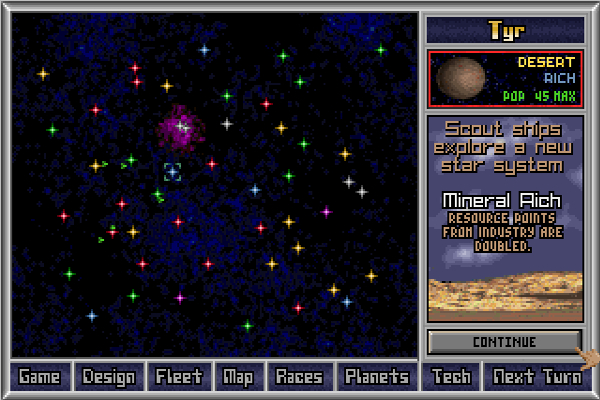
Close by the edge of the Horsehead Nebula, somewhere near the center of the galaxy, lies a small unregarded pale-blue sun. Orbiting this at a distance of roughly ninety-eight million miles is a windswept, dune-covered desert planet whose cactus-descended life forms are so amazingly advanced that they can survive among the sun-baked sands of their desert merely by absorbing nutrients from the air and very occasional rainfall, taking their energy directly from their star - from Tyr.
It all depends on your perspective.
The cactus-descended inhabitants of Tyr 2 had never heard of digital watches, still less the Hitchhiker's Guide to the Galaxy, and if they were at all unhappy about either failing, they never seem to have admited it to anybody. We might all learn something from the Tyrians, if we happen to be capable of living out our lives rooted to rare patches of bedrock among shifting sands while spending every microdrop of water dear. Also if we find ourselves wanting to do so for some reason.
Still, theirs is a very successful survival strategy in the blue-hot light of Tyr, and learning to share their planet with them - probably by establishing them in agricultural fields and harvesting them for their cactusflesh and prickly pears - was soon a virtual obsession among Betelgeuse's people ... although this may have had less to do with the planet's life forms than with its sand, whose silicon dioxide grains, always resistant to weathering, were mingled with even more resistant grains of neutronium.
_______________
NEXT: Stumbling Forward
